
Right to light claims, fully funded from the first letter to the final settlement
Searching for "right to light no win no fee"? That covers the solicitor. It doesn't cover the surveyor... You pay nothing unless we win.
Free pre-assessment
Send us your address and the development (a name, an address or a planning reference is enough). We look at the scheme, your title and whether the light to your rooms is likely to be affected. You can have an answer in as little as two hours, and it costs nothing.


Sign up, fully covered
If it's a runner, you sign the Daylight Protect Claim Plan and the solicitors' no win, no fee agreement, and the insurance is put in place. From that moment the surveyor, the solicitors, counsel, court fees and the other side's costs are all covered. You have 14 days to change your mind.
Letter of claim, analysis, negotiation
Your solicitors put the developer formally on notice, which protects your position and gets their attention. A specialist surveyor models the loss of light room by room using the Waldram method. Most claims settle from here, because the developer can see the claim is equipped to go the distance.


Settlement, or court if it comes to that
Where a developer won't engage, your team is already in place and already covered to issue proceedings, at no cost to you. When the claim succeeds, compensation is paid, the agreed percentage comes out, and the rest is yours. Nothing else to pay.
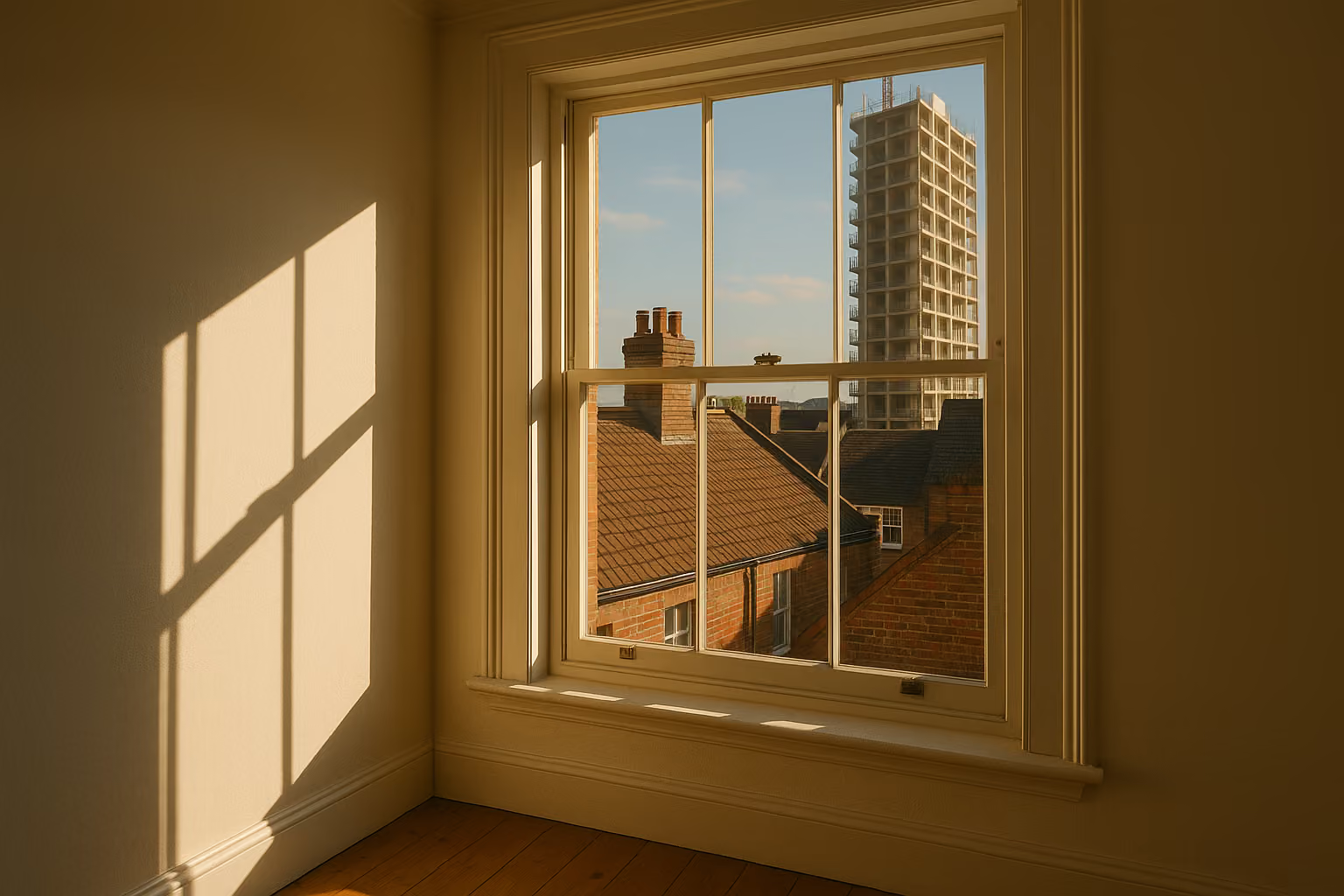
You own a home, a flat or a commercial property. A development next door, behind you or across the road is planned, under way or recently finished, and it's going to take light from your windows. Maybe you objected at planning and lost. Maybe you didn't know about it until the scaffolding went up. Maybe a letter has arrived from the developer's surveyors telling you your light "may be affected".
Either way, planning permission is not the end of the story. A right to light is a private property right, separate from planning, and a developer with full consent can still owe you compensation for interfering with it. Developers know this. Their insurers know it. Most affected owners don't, which is exactly why so many rights of light claims are never made.

"No win, no fee" is shorthand for a conditional fee agreement with a solicitor. If the claim is lost, the solicitor doesn't charge for their time. Useful. Also only part of the bill.
A rights of light claim has costs that a standard agreement will often leave with you:
- The rights of light analysis. A specialist surveyor models the loss of light to each affected room. This is the technical evidence the whole claim rests on, and it isn't cheap.
- Counsel. If the developer digs in, you'll want a barrister's opinion, and possibly a barrister in court.
- Court fees and other expenses. Issuing proceedings costs money before a judge has heard a word.
- The other side's costs. In litigation, the loser usually pays the winner's legal costs. A developer's costs on a contested claim can run well into six figures.
So before you sign anything with anyone, ask one question. Who is paying for those?
All of it is covered. From the first letter to the final settlement, there is nothing for you to pay up front, nothing monthly, and no costs to you either way.
- Rights of light analysis by a specialist surveyor using the Waldram method, the recognised measure in rights of light disputes
- Solicitors from our panel, a Legal 500 ranked property litigation firm, acting for you under their own no win, no fee agreement
- Counsel where the claim needs it
- Court fees and other expenses if proceedings are issued
- Insurance included in the plan, from a specialist legal insurer, so the developer's costs are covered if the claim doesn't succeed
And one thing most people never think to ask about: your solicitors' charges are paid out of what's recovered from the developer, not out of your share of the compensation. If that recovery falls short, the difference is never passed to you.
Our fee is a percentage of the compensation recovered, agreed in writing before you sign. If nothing is recovered, nothing is paid. No recovery, no fee. See the case studies.
A rights of light claim is a negotiation about leverage. The developer's real fear isn't a compensation cheque. It's an injunction, or a court ordering part of a finished building to come down. That's what brings them to the table.
But a threat only works if it's credible. An owner who can't afford to issue proceedings has no leverage, and developers and their advisers can tell within one letter. An owner with a specialist surveyor, a Legal 500 firm, counsel and insurance already lined up is a different conversation entirely.
That's the whole point of the fully funded solution. It isn't a payment plan. It's what makes the developer take the claim seriously, and in our experience it's why fully funded claims settle for more. It's how Daylight Protect has recovered more than £15,000,000 for hundreds of clients.
A right to light is a legal easement: the right to receive enough natural light through a particular window or opening. It usually arises once a window has enjoyed that light, uninterrupted, for 20 years, under the Prescription Act 1832. It can also be granted in a deed.
Three things it is not:
- It's not a planning matter. Planning permission doesn't cancel it, and the daylight and sunlight assessment in a planning application tells you nothing about whether you have a claim. Different law, different test, different people.
- It's not a right to a view, or to direct sunshine, or to keep every bit of light you have today.
- It's not automatic. Some deeds exclude it, some light can be obstructed lawfully, and some public schemes are protected.
The legal test is whether, after the development, the room still has enough light for ordinary use. If it doesn't, the law gives you two remedies: an injunction to stop or cut back the offending part of the scheme, or damages in its place. Because a court can assess those damages by reference to what the developer gains from building into your light, not just what your property loses in value, the numbers can be significant. In 2025 the High Court ordered a developer to pay £850,000 to two flat owners for the light its new tower took. What that judgment means for property owners.
You may well have a claim if:
- A development, extension or roof addition is planned, under construction or recently completed close to your windows
- The affected windows have been there for 20 years or more
- The rooms behind them are in regular use: living rooms, bedrooms, kitchens, offices, studios
- You own the property, as freeholder, long leaseholder or share of freehold
- The reduction in light will be noticeable, not marginal
Things that can defeat a claim: a deed or lease that excludes rights of light, a light obstruction notice registered against your property, or a scheme built by a local authority or its partners using section 203 powers. We check every one of those before a letter goes out, and it costs you nothing to find out. Why some claims fail before they start.
It depends on three things: how much light you lose, how much of the developer's scheme is causing it, and how much that part of the scheme is worth to them.
The last one is what surprises people. A court valuing your claim can look at the developer's gain, not only your loss. A modest reduction of light to a bedroom window can be worth far more than any "diminution in value" figure, because the developer's alternative is to lose the floor, or the wing, that's taking it. How compensation is really calculated.
Nobody honest will give you a figure before the analysis is done. What we can say is this: if the claim isn't worth pursuing, we'll tell you, because nothing is paid unless it succeeds.
You could. Here's what usually happens.
The solicitor wants a surveyor's report before they'll advise. The surveyor wants paying first. If the report is good, the solicitor may offer no win, no fee on their own time, but the expenses are still yours, and insurance against the other side's costs is a separate conversation with a separate premium. You end up project managing three professionals and writing cheques before anyone can tell you whether the claim will pay. The three ways to run a claim, compared honestly.
There are other no win, no fee services for rights of light, and some of them are perfectly legitimate. The difference is usually the contract, not the people.
Most alternatives work on a damages-based agreement: a single percentage of your compensation that has to cover the company's fee and the legal costs. That sounds simple, but it means the professionals are paid by shrinking your share. Under the Daylight Protect Claim Plan, the solicitors work under a conditional fee agreement, their charges are recovered from the developer as far as possible, any shortfall is never passed to you, and the insurance included in the plan covers the expert bills, court fees and the other side's costs if the claim fails. Two services can quote a similar percentage and leave you with very different amounts.
Ask any provider, including us, for a written worked example at a realistic settlement figure, showing every deduction and what actually reaches you. Here's ours, next to a typical damages-based agreement.
Yes, and it goes further than most agreements of that name. The solicitors don't charge if the claim fails, and the surveyor, counsel, court fees and the developer's costs are dealt with by the fully funded solution and the insurance included in the plan. Provided you follow your solicitors' advice and cooperate with the claim, which are standard conditions in any agreement of this kind, there's nothing for you to pay if it doesn't succeed.
Insurance from a specialist legal insurer is in place from the start. If the claim doesn't succeed, it covers the developer's costs and the expenses of running the claim. You don't put your hand in your pocket.
Rarely. Most rights of light claims settle because the developer has more to lose from a fight than from a fair settlement. But being ready and able to go to court is exactly what makes them settle, which is why everything is covered before the first letter, not after.
Long leaseholders and shares of freehold usually can. Short-term tenants generally can't. Where a freeholder or mortgage lender needs to consent to a settlement, we manage that as part of the process.
No. Planning and rights of light are separate. Whether you objected, and whether permission was granted, makes no difference to a private right.
Anything from a few months to a couple of years, depending mostly on the developer. Lender consent and freeholder consent, where needed, can add time.
35.6% of the compensation recovered, and that figure includes our fee, VAT and the insurance premium. You keep 64.4%. It's agreed in writing before you sign, and nothing is deducted if nothing is recovered.
Usually it's treated as capital rather than income, and for a main residence there may be no tax to pay at all. Every case is different, so take advice. Our guide to the tax position.
England and Wales. Most of our claims are in London and the South East, where the density of development makes rights of light disputes most common, but the law is the same everywhere.
Find out if you have a claim
Send us your address and the name, address or planning reference of the development. We'll tell you, at no cost and with no obligation, whether it's worth pursuing.
Previous successful claims
Set up in 2019. One point of contact, specialist surveyors, Legal 500 panel solicitors, counsel when needed, fully funded. £15,000,000+ recovered for hundreds of clients.
Not a law firm, not a claims company: a litigation facilitator led by an MRICS chartered surveyor. Call 0800 955 4448 or start a free pre-assessment.
Daylight Protect is a litigation facilitator, not a firm of solicitors. We arrange and manage rights of light claims on a no win, no fee basis; legal work is carried out by independent specialist solicitors who act for you. Our fee is payable only if your claim succeeds.
Daylight Protect
Daylight Protect evolved from the amalgamation of expert knowledge in property and urban planning. It was established to address the balance of power and give the claimant a voice. Many developers have neglected to manage the issues surrounding a claimant's entitlement to Rights of Light. The root cause of this imbalance has been the claimant's lack of knowledge and their inability to get viable representation. There is a common misconception that the granting of planning permission gives a developer the right to infringe on the light of another. This is simply not true. The Daylight Protect Claim Plan was developed to assist you in circumstances where new, proposed or recent developments have an impact on your light.
Whether you're looking for a way to halt the construction, remove the offending part of the development or receive financial compensation, Daylight Protect are here to help you. Call us now on 0800 955 4448. Our comprehensive hassle free, one-stop service will manage your claim through to conclusion, on a genuine no win, no fee basis. It all starts today with a simple pre-assessment as to whether you have suffered an adequate loss of light to make a claim and receive compensation. We will then pass your claim to one of our expert panel solicitors and surveyors to advise on the best possible solution for your individual circumstances.